Upcoming event
9th of July 2026 – ESRF Auditorium
Grenoble cryoEM club meeting #6
9:00 Meeting introduction
9:10 Tristan Wagner, IBS, Grenoble, FR
9:30 Jill Von Velsen, EMBL Grenoble, FR
9:50 Thibault Legal, IBS Grenoble, FR
10:10 Jiangfeng Zhao, EMBL Grenoble, FR
10:30 Coffee break
11:00 Keynote talk: Ariane Briegel, Institut Pasteur, Paris, FR
Keynote speaker
Ariane Briegel
Institut Pasteur, Paris, FR
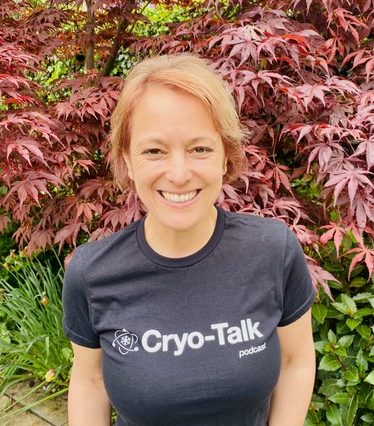
Keynote talk
Pushing the boundaries of cryo-microscopy to gain insight into host-microbe interactions
How are bacterial cells able to actively seek out their preferred environmental niches? How can they evade toxins and predators? How do they interact with phages, each other and their host tissue on a structural level? Cryo-electron tomography (cryo-ET) is our key research tool to gain insight into the structure and function of the molecular complexes involved in these behaviors. This technique allows us to directly study microbes in their native state at resolutions capable of visualizing individual proteins. However, studying how microbes interact in more complex environments, such as host tissue, is still dauntingly difficult. Here we apply a large volume processing pipeline to study a naturally simplified host microbe system where one organism, the Hawaiian bobtail squid, interacts with only one species of bacteria. Once the squids hatch, the light-producing bacterium Vibrio fischeri in the surrounding seawater migrate toward and into the squid’s internal light organ, where they colonize and maintain a light-producing population for the lifetime of the squid. This makes the animal invisible for predators at night, as the animal is camouflaged against the moonlight shining from above. This binary host-microbe interaction is an ideal system to begin to understand the structural interplay between these organisms at the nanoscale.